What is a Smart Hospital? Revolutionizing Hospitals with Technology.
Table of Contents
What is a Smart Hospital? A Deep Dive into Smart Hospital Technology in 2026
A Smart Hospital is a hospital that adopts advanced digital technologies—such as the Internet of Things (IoT), Artificial Intelligence (AI), Big Data, and medical robotics—to connect and manage the entire healthcare service system. The main goal is to increase treatment efficiency, reduce redundant steps, create the best possible Patient Experience, and simultaneously reduce the workload of medical personnel.
The primary objective is not simply to adopt new technologies, but to use them to:
- Increase efficiency: Reduce redundant steps and waiting times, and streamline operational processes.
- Enhance the quality of care: Provide doctors with complete and immediate access to patient data, enabling more accurate diagnoses and treatment plans.
- Improve the patient experience: Make receiving care easy, convenient, and less stressful.
- Lessen the burden on staff: Use automation and robots for tasks that don’t require advanced skills, freeing up medical personnel to focus on patient care.
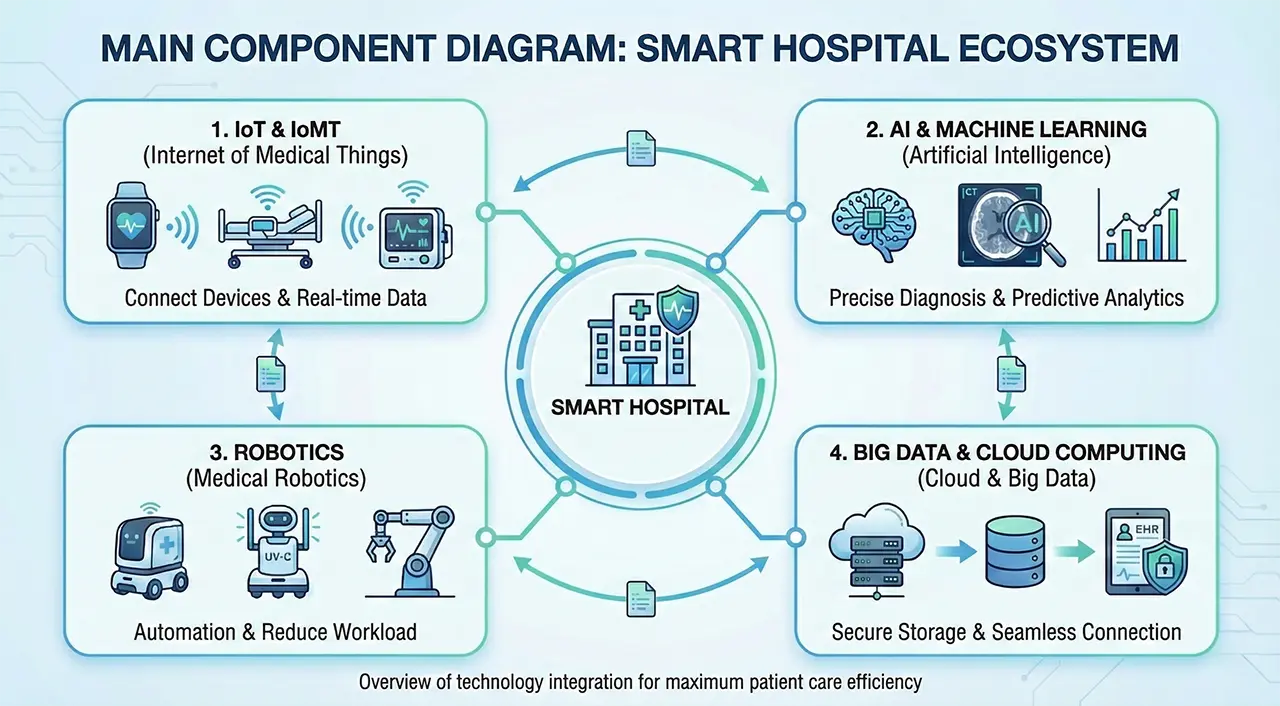
What are the key components of a Smart Hospital?
A Smart Hospital isn't driven by a single technology but by the collaboration of several key ones:
1. Internet of Things (IoT) and IoMT: The use of Wearable Devices and sensors to track patient vital signs in real-time, connecting data directly to the Nurse Station without the need for staff to walk around and record notes manually.
2. Artificial Intelligence (AI) and Machine Learning: Using AI to assist in diagnosing diseases from CT Scan/MRI images more accurately and quickly than humans, as well as using AI to forecast patient risks (Predictive Analytics).
3. Robotics (Medical Robots):
-
Medicine and Supply Delivery Robots: Reduce the workload of staff walking to deliver items.
-
Cleaning Robots: Automatically disinfect areas using UV-C light.
-
Reception Robots: Assist in guiding patients and answering preliminary questions.
Telemedicine: An online medical consultation system that allows patients in remote areas to access treatment without traveling, thereby reducing overcrowding in the hospital.
5. Big Data & Cloud Computing: The storage of health records (EHR) on a secure cloud, seamlessly linking data between departments and hospitals within the network.
Benefits of a Smart Hospital (Why Change?)
| Features | Traditional Hospital | Smart Hospital |
| Data Access | Paper files, hard to search | Digital data, Real-time on Cloud |
| Appointments | Phone, waiting in queue at counter | Application, Online booking |
| Patient Monitoring | Scheduled rounds/checks | 24-hour monitoring via IoT |
| Errors | Higher Human Error | Reduced errors with AI and Automation |
Benefits for Patients
-
Reduced Waiting Time: With smart appointment and queuing systems.
-
Accurate and Safe: AI helps scan for abnormalities that may be invisible to the naked eye.
-
Convenient: Access treatment history and test results via mobile application.
Benefits for the Hospital
-
Cost-Effective Resource Management: Reduces energy costs and paper usage.
-
Solves Staff Shortage Problems: Uses robots to perform repetitive tasks instead of humans, allowing staff to focus on patient care.

How Must Hospitals Adapt to Become Smart Hospitals?
The transition isn't just about purchasing equipment; it requires preparation of the Infrastructure:
1. Network Backbone: Install Wi-Fi 6 or 5G systems to cover every area to support a massive amount of IoT devices.
Cybersecurity: Implement data security systems that strictly adhere to PDPA standards.
Physical Space: Adjust walkways to be wide enough (at least 120 cm) and flat so that robots can pass each other, including integrating elevators that can receive commands from robots.
Real-World Examples of Smart Hospitals
- Rajavithi Hospital: Uses temiV1 robots to send blood samples from the clinic to the Lab and uses them as document sender robot for various internal tasks, significantly reducing the walking burden for hospital staff.
- Siriraj Hospital:: The prototype for the first 5G smart hospital in ASEAN. It features Smart Logistics with driverless vehicles for drug delivery and Smart EMS, a smart ambulance that transmits patient vital signs to the doctor before arriving at the hospital.
- Mount Sinai Hospital (New York, USA): Uses AI to analyze patient data to predict the risk of complications after surgery.
- Cleveland Clinic (Ohio, USA): Uses Big Data to analyze information and improve operational efficiency while reducing costs.
- Changi General Hospital (Singapore): Uses IoT to monitor patients' symptoms and an intelligent navigation system to help patients and their families move around the hospital.
The future of healthcare has already begun.
Smart Hospitals are no longer a distant concept but a direction that healthcare systems worldwide, including in Thailand, are moving towards. Investing in these technologies is an investment in a sustainable future, one that will provide everyone with access to safer, more effective, and higher-quality healthcare than ever before.
Request a Demo
Please provide your complete information.